
Neurofeedback vs. Biofeedback vs. HRV Training
Most articles about nervous system technology read like they were written by clinics trying to sell their own equipment. This is not that. If you are reading this, you are probably an adult who has already tried the obvious things. You have read the books. You have done the meditation app. You have a wearable. You may have even tried therapy or coaching. Something is still off, and you want to understand the actual technology landscape before you spend another dollar.
Here is the honest version.
The Short Answer
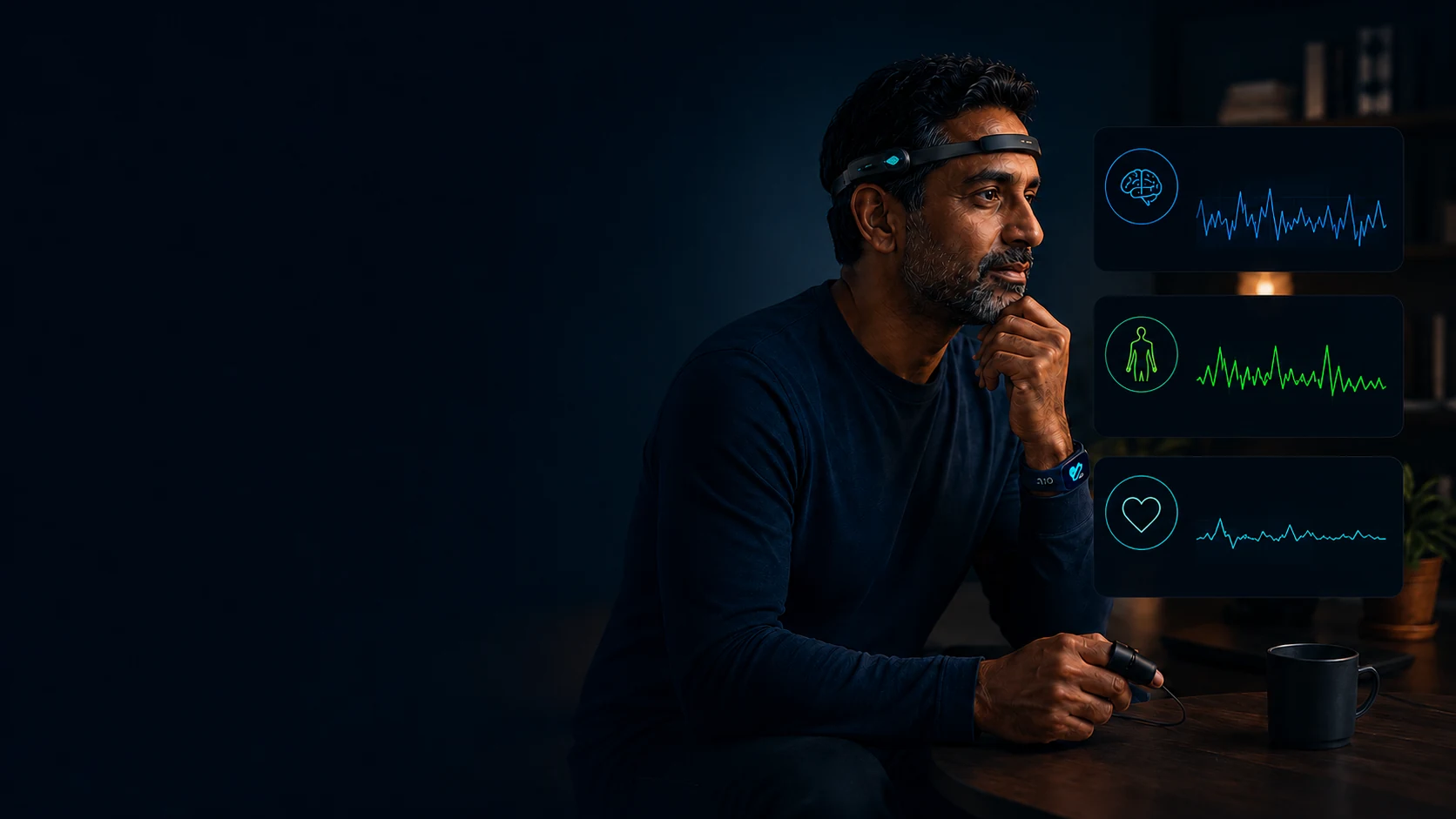
Neurofeedback, biofeedback, and HRV training are three different tools that measure three different signals in your body and use that measurement to teach you something. Neurofeedback measures your brainwaves. Biofeedback measures other physiological signals like skin conductance, muscle tension, or breathing. HRV training measures the variability between your heartbeats as a proxy for nervous system flexibility.
They are often grouped together because they share the same underlying logic. Your nervous system operates largely below conscious awareness. If you can see what it is doing in real time, you can begin to influence it in ways that pure willpower never reaches. The differences between the three come down to which signal you are reading and what you are trying to train.
The mistake most adults make is treating these as interchangeable. They are not. Choosing among them well requires being honest about what you actually want to change.
What Each Modality Actually Measures
Neurofeedback uses electroencephalography (EEG) sensors placed on the scalp to read the electrical activity of your brain in real time. The output is your brainwaves: delta, theta, alpha, beta, and gamma frequencies that correspond to different states of awareness. A neurofeedback session shows you what your brain is doing and rewards you, usually with audio or visual cues, when it produces patterns associated with the state you are training toward.
Biofeedback is a broader category. It includes any technology that measures a physiological signal and shows it back to you. The signal can be skin conductance (how much you are sweating, which tracks with arousal), muscle tension (used heavily for chronic pain and tension headaches), peripheral temperature (your hands get colder under stress), or breathing patterns. Some practitioners include heart rate and HRV under the biofeedback umbrella, which is why the terms get muddled in popular usage.
HRV training is technically a form of biofeedback that focuses on heart rate variability. HRV is the millisecond variation in time between heartbeats. Counterintuitively, a heart that beats with more variation is healthier than one that beats like a metronome. High HRV is one of the cleanest available proxies for nervous system flexibility and the ability to recover from stress. HRV training teaches you to breathe and engage your body in ways that increase that variability over time.
A useful way to hold it: neurofeedback reads your brain, biofeedback reads your body, and HRV training reads the dialogue between the two through your heart.
Neurofeedback: What It Does Well, What It Doesn't
Neurofeedback has thirty years of clinical evidence behind it, particularly for attention disorders, anxiety, and some forms of trauma. When delivered by a trained clinician with proper assessment, it can produce durable changes in brainwave patterns and the subjective experiences those patterns produce.
The honest limitations: clinical neurofeedback is expensive. Sessions typically run $80 to $150 each, with most protocols requiring 20 to 40 sessions. The qEEG brain map used to set the protocol is itself a significant investment, often $500 to $1,000 on top of the sessions. Home neurofeedback devices have improved dramatically in recent years, but most operate on a much simpler protocol than a clinical setup and lack the personalization that makes the clinical version work.
The other limitation is harder to talk about. Neurofeedback is excellent at changing brain state during the session. Whether those changes translate into how you respond to a hard conversation with your team, a difficult board meeting, or a Sunday evening when the week ahead suddenly feels heavier than usual is a different question. Brainwave training is upstream. It does not automatically rehearse the situations where you actually need the regulation.
Biofeedback: What It Does Well, What It Doesn't
General biofeedback is the oldest of the three, the most studied, and the most widely covered by insurance for specific clinical applications. If you have chronic tension headaches, certain types of pelvic floor dysfunction, or stress-related GI symptoms, biofeedback has a strong evidence base and is often the right starting point.
For the adult who is not in a clinical condition but is feeling depleted, reactive, and stretched thin, general biofeedback runs into a different problem. The signals it measures are often consequences of a dysregulated nervous system rather than causes. Bringing your skin conductance down or your muscle tension down is useful, but it can be treating the smoke rather than the fire. People who train only on these downstream signals often report short-term relief that does not hold under real-world pressure.
Biofeedback also tends to be skill-focused. You learn the technique, you get better at the technique, and you can produce a calmer signal on demand. Whether that translates into a calmer response when your nervous system is actually under load is, again, a separate question.
HRV Training: What It Does Well, What It Doesn't
HRV has become the most popular of the three among performance-focused adults, partly because of consumer wearables and partly because it correlates so cleanly with nervous system flexibility. A well-designed HRV training protocol can measurably increase your baseline HRV in four to eight weeks. That increase tracks with real changes in how quickly you recover from stress and how much capacity you have for sustained focus.
The first honest limitation is resolution. Most wearable-based HRV training is undertrained. Your Apple Watch, Whoop, or Oura ring is sampling your heart rate for roughly 15 seconds out of every hour and averaging the result. You are then making lifestyle decisions about your rest and recovery based on data that is far less granular than the dashboard you would tolerate for any other important system you manage. The reading is real. The resolution is not high enough to train against in real time.
True HRV biofeedback uses continuous, beat-to-beat measurement, usually through a chest strap or finger sensor connected to software that shows you the waveform live. With that resolution, you can practice slow, paced breathing and watch your HRV rise within seconds. The skill transfers. People who train HRV this way often report that their baseline regulation under pressure measurably shifts within a month.
The second honest limitation is the one most consumer HRV products do not advertise. Most of them, including the popular incumbents like HeartMath, emWave, and Inner Balance, train coherence as their target. Coherence is the organized rhythm your heart settles into when your breathing, heart rate, and blood pressure synchronize, usually around six breaths per minute. The device detects whether you are in that rhythm and rewards you for staying there. The longer you sit in the good state, the better your number.
That is regulation training, and it is real and valuable, but it has a structural blind spot that almost nobody in the industry will tell you about. It cannot distinguish a genuinely flexible nervous system from one that is frozen in a calm-looking state. Someone who is shut down, dissociative, or in a parasympathetic freeze can show beautiful coherence on the readout while being functionally stuck. The system rewards them for it. They get the points. They get told they are doing it right. And their nervous system learns, quietly, that the way to win is to stay still.
This is the limitation that the next generation of HRV-based programs is built to address, and it is where the conversation gets interesting.
The Question Nobody Asks: What Are You Actually Trying to Change?
Most comparison articles stop at the technical differences. The more useful question is functional. There are roughly three reasons adults look at this technology.
The first is symptom management. You have a specific issue (headaches, focus problems, anxiety, sleep disruption) and you want it to resolve. Choose the modality with the strongest evidence base for that specific issue and work with a qualified clinician. The technology choice matters less than the clinical fit.
The second is performance optimization. You are functional, often high-functioning, but you can feel that you are operating closer to capacity than you used to. Recovery takes longer. Reactivity is higher. You are second-guessing decisions you would have made cleanly two years ago. This is the use case where structured HRV training, properly delivered, tends to outperform either of the other two on a cost basis.
The third is what could be called nervous system retraining. You are not in a clinical condition and you are not chasing a single performance metric. You are trying to expand the underlying capacity of your nervous system so that all of the above improves together. This is the case where a single modality usually falls short, and where the next-generation approach has clear advantages.
Why a Single Modality Often Falls Short
The body and the brain are not separate systems. Your brain interprets signals from the body, and your body responds to interpretations from the brain. A loop. If you only train one side of the loop, the other side often pulls you back.
This is why people who have done HRV training for a year sometimes plateau. The body has learned the skill, but the perceptual and cognitive habits that triggered the dysregulation are still running. It is also why people who have done years of clinical neurofeedback sometimes report that they feel calmer in session but not durably calmer in their actual life. The brain has been trained, but the body has not been brought into the loop in a way that locks the change in.
There is a principle that sits underneath all of this. The brain cannot observe itself and stay the same. The same is true of the body. When you give either one accurate, real-time information about its own state, change becomes possible in ways it never is when the system is operating blind. The catch is that observing one without the other still leaves a gap.
The Distinction Most Articles Miss: Calm Is a State, Recovery Is a Skill
Here is the piece that almost no comparison article will tell you, and it matters more than any of the technical differences above.
A regulated nervous system is not one that stays in a low-arousal state. It is one that can be challenged, move into activation, and then return. The return is the skill. Most adults who come to this work have nervous systems that can activate just fine. What they have lost, or never built, is the ability to come back down efficiently and repeatedly. Life does not ask you to stay calm. It asks you to handle the hit and reset before the next one arrives.
This is the distinction that exposes the limitation of coherence-only training. Coherence systems reward time-in-target. The longer you sit in the calm state, the better your score. That quietly trains stillness, and it cannot tell the difference between a person who is genuinely flexible and a person who is frozen. For the audience that this technology is most often sold to, that distinction is the whole game.
The next-generation approach trains the move rather than the destination. It rewards recovery events specifically, where the system moves from a worse regulation zone to a better one and holds that improvement for long enough to be real. It treats challenge as the gym equipment rather than the enemy. A session with no challenge produces no recoveries and therefore trains nothing about resilience. You cannot build the capacity to return without first leaving.
Each successful recovery is a rep. Eight recoveries in a session is eight reps of "I went up and I came back." Over weeks, that repetition is what shifts the baseline, because the system updates its underlying prediction about what activation means. The autonomic nervous system, like any other system in the body, adapts to what it does repeatedly. If what it does repeatedly is return, that is what it gets better at.
What the Next Generation Looks Like
The frontier in this field is not a better single-modality device. It is integrated programs that combine measurement of multiple signals, an environment that engages attention and emotion the way real life does, and structured practice over enough weeks to actually shift baseline capacity.
A few features distinguish the newer programs from the older single-modality approaches.
Continuous measurement during practice, not 15-second snapshots. Wearable averages are not enough resolution to train against. Beat-to-beat measurement during the session is.
Two channels of physiology, not one. Reading vagal tone and activation-recovery dynamics simultaneously is what makes states that look identical on a coherence-only readout (genuinely flexible versus frozen-but-calm) distinguishable in real time. Note that the second channel is best understood as a within-session feedback signal during training, not as a diagnostic of autonomic balance. The science there is more nuanced than the wellness industry often acknowledges, and any product that claims otherwise is overstating what the measurement can do.
A scoring architecture that rewards the move, not the staying. A recovery is defined as a sustained improvement, held for a measurable interval so that a flicker does not count and only a real return does. When both physiological channels improve together, the recovery is weighted more heavily, because that simultaneous shift is the strongest real-time signal that the whole autonomic system is moving together rather than one piece compensating for another.
An immersive environment that engages the right circuitry. This is where virtual reality has earned its place in the protocol, and where it stops being a novelty wrapper. The immersion literature is clear that VR recruits the same embodied-simulation, motor, and mirror-neuron circuits as real experience. State regulation learned in that environment gets encoded in the circuits that actually fire under stress. A 2D coherence bar on a phone screen does not do that. This is the most evidence-backed claim in the entire next-generation category, and it is the one that explains why VR-delivered protocols are starting to produce results that 2D feedback protocols do not.
A structured arc with an end date. Five to eight weeks rather than open-ended training. The arc creates accountability, sequencing, and a clear before-and-after.
A subjective longitudinal measure alongside the objective one. How you experience your nervous system across weeks matters as much as the in-session waveform. Most programs measure one or the other. Serious ones measure both.
This is the category XRegulation occupies. It is a five-week home program that combines immersive VR-delivered training with continuous HRV biofeedback. It defines recovery events explicitly, scores them in a way that rewards the return rather than the staying, and tracks change across both an objective per-session metric (HRV) and a subjective longitudinal one (the Nervous System Coherence Index). It is delivered as a complete kit rather than an open-ended app. The clinical version of this same approach, with qEEG mapping and in-person coaching, runs $12,000 or more. The home version is under $3,000.
XRegulation was not built because the other modalities do not work. It was built because the gap between what a single modality can do and what most adults actually need was wider than any of them were willing to name out loud. And because the difference between training calm and training recovery, once you can see it clearly, is not a small one.
How to Choose
Three questions tend to cut through the noise.
What are you actually trying to change? If it is a specific clinical symptom, work with a clinician in the modality with the strongest evidence base for that condition. If it is performance and capacity, you are looking at the second or third use case above, and a structured program is usually the better return on investment than buying a device and figuring it out alone.
What is your relationship to data? Some adults thrive on raw HRV data and a Whoop will get them further than any structured program. Most do not. If you have tried tracking your way to better regulation and it has not worked, more data is unlikely to be the answer. Structure usually is.
What is the time horizon? A device is a tool. A protocol is a path. If you are looking for something to use as an ongoing daily practice for the next decade, a good device may serve you well. If you are trying to shift your underlying capacity in a defined window, a structured program is built for exactly that.
If your answer to those three questions points toward nervous system retraining rather than symptom management or open-ended tracking, the XRegulation consultation is the right next step. Calm is a state. Recovery is a skill. Only the skill transfers.